Remote work has created a fundamental shift in business culture, and the Ooma team created a graphic demonstrating that a company’s age can indicate how likely a business is to adapt to remote work. Their analysis revealed that 35% of workers had remote jobs in 2023 compared to 23% in 2019. It’s obvious that the COVID-19 pandemic caused this shift. Looking at the team’s numbers, newer companies seem more likely to embrace remote work. Almost 44% of businesses under two years old support work-from-home options, suggesting they could design their work models on remote possibilities.
In the last few years, the popularity of remote work has skyrocketed. In fact, as many as 40% of employees work from home at least 1 day a week. This popularity varies on a per-state basis, with major states like Texas and California having a higher demand for remote work. However, this popularity is driven by the merits of remote work.
Since the COVID-19 pandemic, remote work has exploded in popularity; by 2025 an expected 22% of the workforce will be entirely remote. Remote work isn't without its flaws as being in your home while working can lead to a lack of a separation between home and work which causes burnout, stress, and disorganization. These workers are much more likely to be working over 40 hours a week and the combined challenges of remote work are leaving many short of where they should be.
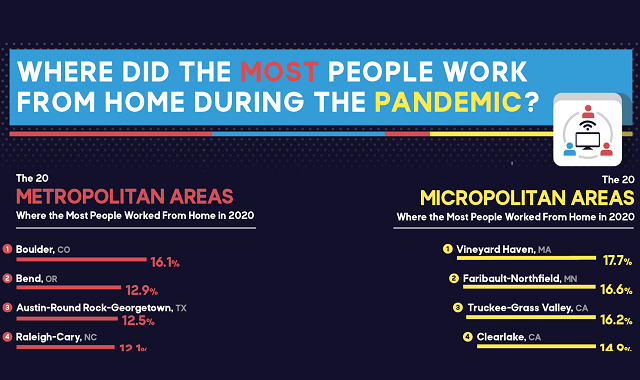
Where did the most people work from home during the pandemic? This question is answered by FinancialForce.com, who analyzed data from the 2016-2020 American Community Survey to create a graphic of the 20 metropolitan, and the 20 micropolitan, statistical areas in the United States that had the highest percentage of people that worked from home throughout 2020; when the pandemic was just beginning. If you’re wondering how these early pandemic numbers compare to that of the pre-pandemic era, well this graphic addresses that question as well.
LinkedIn has started a new conversation around the changing
work environment and people’s adjustments to the new ‘work from home’ setting,
through its latest promotional campaign.
LinkedIn is examining the changes in work environment and is
giving people a chance to express their thoughts, feelings, and concerns
regarding the new shift. As stated by the company, “It’s a change in not just
how we work, but why we work and a shift in how people are making work, work
for them. With this comes a change in how the world is defining what being
“professional” really means - and we want to hear what it means to you.”
The company has released an ad of the campaign that talks about “what being professional is” and shows how different people in their career have been professional in ways that have become the new norm of professionalism, ever since the pandemic. The company is also working on additional ways of promoting the campaign through different media, so it can spread the stories and messages of people in relation to it.
In today’s work environment, employees and their employers are enjoying the benefits of remote work. It’s a switch that took us by surprise at the beginning for the COVID pandemic in 2020, but in most ways the surprise has been a pleasant one.
Employees are enjoying the ability to work from their own devices with ample workspace. They’re still meeting deadlines and are able to do so with fewer interruptions. They’re motivated and more satisfied in their current positions.
Employees at Apple are not happy with the company’s new work
policy, that requires them to return to the office three days a week starting
in early September. In opposition to the policy, the employees are demanding a
flexible approach, so that only those who want to work remote are allowed to do
so.
The employees wrote a letter to the company where they addressed their concerns, saying that some of their colleagues have already quitted due to the conversation around Apple’s new policy. “Without the inclusivity that flexibility brings, many of us feel we have to choose between either a combination of our families, our well-being, and being empowered to do our best work, or being a part of Apple,” the letter read.
If your business is still using multi-factor authentication (MFA) as a security measure, you need to know that it’s not working for you. You may have already guessed this since cybercrime is up by 300% since early 2020. Since 62% of the American workforce made the sudden switch to remote work at the beginning of the pandemic, 20% of businesses have experienced a cyber security breach which could be linked back to their remote employees.
Remote work has ramped up the cyber vulnerabilities as employees are potentially working from unsecured networks or spotty WiFi, on personal devices which may not have security protocols in place, and they’re connecting to corporate networks remotely, which adds another area for cyber criminals to exploit.
The COVID pandemic of 2020 brought about many drastic changes to our lifestyle, but one of the most affecting changes was that the work-from-home model that many of us had been rooting for in recent years was embraced in full force! Honestly, most of us couldn’t be happier about this. Studies show that 96% of employees want to continue remote work after the pandemic, and 80% of executives say they will continue allowing remote work after COVID. It is expected that, but 2025, 87% more Americans will be working from home than before the pandemic. It seems like both employees and their employers are finally in agreement that working remotely has benefits for everyone.
The COVID-19 pandemic has forced many people in America into full-time remote work over the past year whether they liked it or not. As we start to turn the page on the pandemic, many American workers are considering staying remote if their employer lets them as a permanent working option. Because of this, many people are considering moving from their current location with their newfound freedom to work and live where they like.
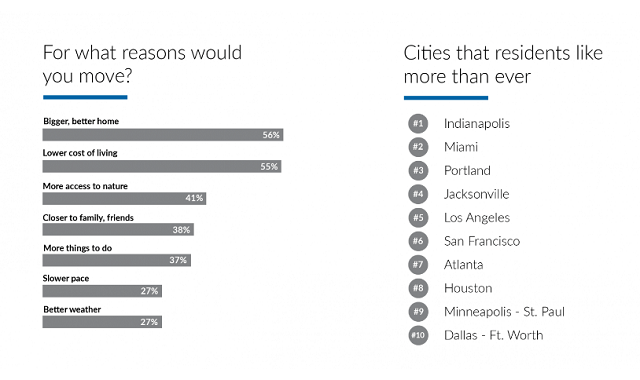
CraftJack recently surveyed 2,888 American workers to learn more about their feelings towards permanent remote work, where they would move if given an option and compensation if relocating. They were eager to see if many Americans would leave the cities they live in currently for more secluded rural locations.
The survey began by asking a simple question to American workers. Would you move elsewhere, if given the opportunity by your employer to work remotely on a permanent basis. The survey found that a resounding majority of Americans (61 percent) said they would move elsewhere if full time remote work was an option. Looking at the most populated cities in America, CraftJack asked what percentage of people living in that city would move if work was permanently remote.
One year after the pandemic shut things down, WFH has changed the way business is done - possibly forever. During the pandemic, an incredible 88% of organizations worldwide have encouraged or required employees to work from home. This migration of workers is finally proving out the WFH (work from home) model for all.

The entire 2020, no one was able to work from their offices the way they used to due to the global pandemic of Covid-19. Every company shifted its employees to work from home whereas, several companies reduced their number of employees due to the declining economic conditions. But, what about the entrepreneurs? Did the entrepreneurs also face trouble during the lockdown or did it impact their work life positively?

Remote working has become mainstream in 2020 because of the global pandemic. Work from home will not only save you from contracting Covid-19 but also help you in balancing your work and life together. Companies not in the UK, but the entire world has enforced remote workforce due to the second wave of Covid-19, those who were called back to the offices are sent home back once again. However, many of the employees that are sent back home won’t ever come to the office again as remote jobs have been extremely efficient, time-saving and allow the company to hire more staff.
According to the studies, remote jobs are likely to double in the coming year, which will result in one-third of the world’s professional working in the clouds. Remote jobs are now becoming a new way to deliver your services to a company from your home, and it is a whole different work landscape that almost every company has adopted.

The popular Square Enix studio has recently announced its permanent policy to let the employees work from home from December. The first wave of coronavirus caused a global shutdown, which led most of the employees to work and operate their businesses from home. However, after the post-Covid season started, many offices and institutions resumed their onsite work policy, and for a while, the situation seemed to be under control and almost back to normal. Unfortunately enough, the virus did not stop and continued to rob people of their lives and health, and eventually, the pandemic season began.
If you think there is no fun working from home, well think again. Working from home can be dull for some people, whereas it can be fun and flexible for others. Whatever your case is, there's a lot to work from home than just working. There's more to all the stress being built up and hardly taking any breaks. Sounds too good to be true? Let's see how it is.
Since working from home is in the trends, it can get hectic having to stay inside at all times. In the UK, the trend has gone so big that almost half of the percentage of employees are working from home. And working from home can get very hard with the work hours extending more than ever. So people have found all kinds of entertaining activities to do at home and to make their work from home lives better, they look up tips and tricks on the Internet.
Work from home has been on the rise in 2020, all thanks to the global pandemic. While remote working may not be new for many workers, it's new for those who have to work from home for the very first time because of the prevailing lockdown situation. Having said that, working from home is possible with or without a pandemic. A huge credit for this possibility goes to the Internet becoming available at a mass scale. A good Internet connection and the basics of technological know-how are all you need to land a good work from home job.
The amount of growth with a work from home job is the same as an office job. The work is pretty serious too. But working from home has plenty of benefits that a regular office going job will never be able to give. First things first, flexible working hours are what make work from home jobs stand out and apart from the rest. Another huge benefit is that it is less costly. You most likely already have a decent Internet connection and a computer, and that is all you need. Expenses are saved in the areas of transportation and commuting especially.
Since the coronavirus pandemic, everyone was confined in
their homes. Closures of public places, businesses, schools, institutions and
offices made for a very apocalyptic situation. However, the unsung hero rose
from the dark times and saved many people and businesses. That unsung hero is
the internet.
Thanks to the internet, we were able to not feel the adverse
effects of the pandemic because everything is now possible remotely. At first,
people were a little skeptic and confused about the work but after a while
everything switched to remote working. We all got used to the new normal which
was stay home and save lives.
With everything about pandemic going on in the world these
days, the paradigm has shifted towards the virtual or digital world. People are
now more aware of the digital aspects and technology because everything was
being done remotely after the world closed down. Businesses that already had an
online presence did very well in somewhat maintaining their business; however,
others weren’t that lucky.
A couple of decades ago, videophone, which is now commonly
known as video calling, was a pipe dream and a thing of fantasy. It was only
possible in a sci-fi movie in the future. Fast-forwarding to today, we are now
in the prime of technological advancements. The Internet has saved many
businesses from being overrun by the pandemic, and virtual meetings have become
a new normal.
During the pandemic, most of the employees have been forced
to work from their homes. Since that, there have been massive increase in the
remote working and networking with each other. Before the pandemic, there was little
awareness among the people in managing, handling and the pros of remote working
but that has now become a new norm among people.
While we all social distanced ourselves from each other,
internet was the only thing that connected us with one another. Businesses ran
smoothly and people connected with each other to ask about their health. The connectivity
and this network could has made it possible for us to endure the pandemic in a
safe manner.