Visualistan: Apple -->

    Social Items

List of Companies Owned by Apple infographic

It’s a common misconception that Apple was started in Steve Jobs’ parent’s garage. They did eventually expand into the garage, but their first base of operations was actually a bedroom. Don’t believe me? Read the very first paragraph of Owen W. Linzmayer’s 1999 book entitled “Apple Confidential: The Real Story of Apple Computer, Inc.” Regardless of where it truly started, what’s important is where it has gone. So far, it has become one of the biggest companies in the world, and where it’s going is anyone’s guess. I’d venture to guess it will continue to grow by quite a bit before it slows down. 

List of Companies Owned by Apple infographic


As a result of the agreement between Apple and the EU Digital Markets Act (DMA), the third-party iOS app store marketplace AltStore PAL is now live in the EU. The store has been developed by Riley Testut and Shane Gill to accommodate apps that can be self-hosted by developers on their own servers.


To install the app store, an annual subscription fee of €1.50 (plus tax) must be paid, which covers Apple’s Core Technology Fee (CTF). During the installation process, Apple confirms with the user multiple times if they wish to proceed with installing a third-party app, before it finally lets them get through.


AltStore PAL is bringing with it two apps, both developed by Testut himself: the Delta game emulator and a clipboard manager app ‘Clip’. The Delta app is simultaneously also making way to the App Store outside of the EU. According to Testut, AltStore PAL is also open to submissions from third-party developers.


Third-Party App Store for iPhone ‘AltStore PAL’ Goes Live in the EU along with Two Apps


The Delta game emulator is the first game emulator that is available for free on the App Store for the first time. It'll enable iOS users to enjoy the gaming experience on their iPhones almost like a pseudo Nintendo DS or GBA.


The app can be accessed on the App Store in several countries outside the EU, and in the EU, it is making debut with the newly launched third-party AltStore PAL app marketplace. According to Riley Testut, developer of the Delta emulator, both the app versions work the same. Other Nintendo emulators, including a wide range from the original Nintendo Entertainment System and Nintendo 64, are also expected to arrive to the App Store. 


On-screen buttons in the app change their layout and appearance to match the emulated system. Users can also put up extra buttons for different functions such as quick save states and fast-forward, as well as customize their layout.


The Delta app supports Bluetooth controllers like Xbox One Series S or PS5 controllers; and multiplayer for the NES, SNES, N64, and AirPlay streaming too. It also works with some of Nintendo’s non-typical input methods, like the gyroscope and microphone controls.


Delta offers some additional touches as well, like automatic grabbing of the box art for the games and the ability to customize the art using its built-in database or even custom images. Users can also import controller skins and customize them.


Delta was first released as a 1.0 version in 2019, which means that it has been updated and improved multiple times through the years. This will likely make the app one of the most enhanced emulation experiences on the iPhone.

Nintendo’s Delta Game Emulator becomes the First Emulator to Go Live on the App Store


Game emulators that have long been banned from iOS can finally bring their titles to the App Store, thanks to a latest update by Apple. According to Apple, the company is making its App Store restrictions more flexible and letting in retro game emulators.


Game emulators can now join the App Store globally where they can offer downloadable games. Apple, however, made it clear that the games must comply with all of its applicable laws, which means that games providing pirated titles will eventually be banned. This new update will also reduce the hassle for iPhone users for the search of alternate ways to access the games, like relying on third-party app stores.

Apple Announces New Rules for Retro Game Emulators and Music Streaming Apps


A report from Bloomberg states that Apple has advanced the internal testing of new generative AI integrations for its Xcode programming software, and will be making them available to third-party developers this year. 


Additionally, Apple is reported to be exploring generative AI in consumer-facing products; such as automatic playlists in Apple Music, slideshows in Keynote, and AI chatbot / search features for Spotlight search.


Apple’s revamped AI-powered code completion tool is similar to Microsoft’s GitHub Copilot, according to Bloomberg’s report. It applies a large language model (LLM) to predict and complete code strings, as well as generate code to test apps.

Apple is Reportedly Furthering Development of its AI-powered Code Completion Tool


Apple’s research department is pitching a prototype of a new generative AI animation tool ‘Keyframer,’ that enables adding motion to 2D images with prompts.


Apple is keen on exploring large language models (LLMs) in animation for their potential, just like in text and image generation. Earlier, Apple introduced Human Gaussian Splats (HUGS) that creates animation-ready human avatars from video clips, and MGIE that edits images using text prompts, among its latest generative AI projects


In a research paper that the company published last week, it explains that Keyframer is powered by OpenAI’s GPT4 model and collects data in the form of Scalable Vector Graphic (SVG) files. It then produces a CSS code that animates the image based on a text-based prompt. These prompts can be anything that describe how the animation must look like, e.g. “make the frog jump.”


Apple Introduces New Generative AI innovation ‘Keyframer’ that Animates Images


Apple is reportedly launching a new security feature that it has been testing as part of the iOS 17.3 which will be out next week. The feature, called ‘Stolen Device Protection’ is designed to strengthen the iPhone’s protection against hijack attempts to steal user’s Apple ID and any financial information on their device.


More specifically, the feature would prevent the thief from breaking into an iPhone via user’s passcode. Instead, Face ID or Touch ID will be required to unlock the device, and the thief may even have to wait about an hour to make any changes to the user’s data. This means that getting access to sensitive information or wiping out the phone data would be a difficult task.

Apple’s ‘Stolen Device Protection’ Option is Reportedly Rolling Out with the Upcoming iOS 17.3


Apple is briefly halting sales of its Watch Series 9 and Ultra 2 models December 21 onwards. The event that has resulted in this move is a conflict between the company itself and medical device maker Masimo over its SpO2 sensor technology.


Apple is therefore taking necessary measures to protect itself from any potential consequences from the ITC import ban that affects the flagship Series 9 and Ultra 2 models. The ITC ban is concerned with the sales of the Series 9 and Ultra 2 within the US only, therefore the watches will still be available for purchase in other regions.


Masimo filed two distinct cases against Apple: one with the US District Court in the Central District of California and the other with the ITC. In the latter, Masimo argues that Apple committed a breach of its pulse oximetry tech. The current import ban is a result of the latter.

Apple is Under Fire for Allegedly Breaching Masimo’s Pulse Oximetry Tech


The new Android iMessage app ‘Beeper Mini’ that became the first and only easy solution for Android users to communicate with Apple users via iMessage, recently started experiencing technical problems in just less than a week since its launch. More and more users started reporting being unable to send and receive their iMessages in the app. It is speculated that Apple may be responsible for Beeper Mini’s dysfunction.


Beeper Mini was developed as a result of massive efforts that went into figuring out the entire process of how to register a phone number with iMessage, send messages directly to Apple’s servers, and have messages sent back to the device natively inside the app. The toughest part of it, according to CEO of Beeper Mini, Eric Migicovsky, was cracking Apple’s code that detects if the connected device is a legitimate Apple product.

Apple Might Have Stopped the Android App for iMessages from Working

Which Brands Have the Most Loyal Customers?

Companies are always looking into new ways to learn more about their customers so that they can in turn increase their sales. The research team at Qualtrics has released a new infographic that looks at which brands have the most loyal customers out there, basing it on the top 25 brand keys loyalty leaders from 2019 to 2023.

Which Brands Have the Most Loyal Customers? #Infographic


Apple seems to have stopped offering customer support on X, as some users have noticed that they are redirected to the company’s general support page when they attempt sending a direct message to the Apple Support account on X.


To all queries forwarded to the company’s customer support via X, the account responds with an automated reply which prompts the user to continue the conversation “in another support channel.” Additionally, the message includes a link to Apple’s relevant support page.  


Apple Support’s account has also been observed to have changed its profile description from “available every day to answer your questions,” to “we’re here to provide tips, tricks and helpful information when you need it most.”

Apple Support’s X Account is No Longer Offering Help to Customers Directly on X


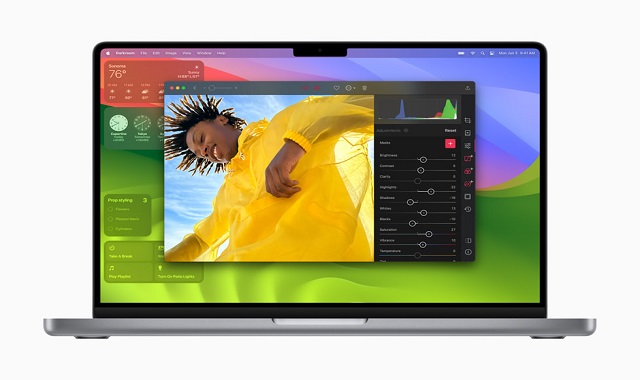
Apple is bringing new features to its Mac devices, as a result of its latest release of macOS Sonoma or macOS 14.0 – the latest Mac software update. The features included in this version are desktop widgets, new screen savers, improved video conferencing and Safari browsing, as well as enhanced gaming performance, and more.


The widgets in macOS Sonoma are interactive and can be placed on the desktop directly as they blend with a Mac’s wallpaper. Users can use these widgets to engage with a number of tasks such as completing reminders, playing or pausing media, accessing home controls, etc. Moreover, users can even add their iPhone widgets to their Mac desktop.


The new screen savers in macOS Sonoma show beautifully captured videos in slow motion of stunning locations around the world. These screen savers flawlessly transition to become the desktop wallpaper once a user is logged in.

Apple Launches macOS Sonoma, the Latest OS Update for Macs Packed with Interesting and Handy Features

Subscribe Our Newsletter