Visualistan: Photography -->

    Social Items

Google just announced software updates for its Pixel phones, that also extend to the Pixel Watch and Fitbit devices. The latest feature drop includes camera enhancements, new personal safety options, and updates to haptics and adaptive charging.


Foremost, the most significant camera enhancement feature is the new ‘macro mode,’ that enables enhanced filming of little details. This, however, is exclusively a Pixel 7 Pro feature and not available for all camera apps or modes.


Moreover, phones from Pixel 6 onwards will be equipped with a new hands-free gesture where you show your palm to the viewfinder frame, to enable a timer when taking photos. Upon detecting the gesture, the camera will count down from 3 or 10 seconds, depending on the set number, and then snap a shot.


Another enhancement feature is the ability to create ‘cinematic wallpapers’ that add more depth to your lock screen, as well as a slick parallax effect. Cinematic photos are not a new Google technology as they have been a Google Photos feature for quite some time now. However, until now users didn’t have control over selecting photos for this effect, and will now be able to create cinematic effect for any photo of their choice.

Google’s New Software Updates for Pixel Phones Include Camera Enhancements, New Safety Controls and More


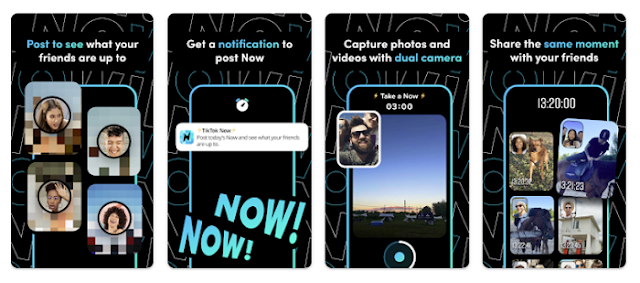
Taking inspiration from social media app BeReal, that is known for its Dual Camera feature, TikTok has created and released its own version of the feature as a separate app called TikTok Now.


The app is centred around the idea of prompting users to connect with friends on a daily basis by sharing a random video or photo at the exact same time as friends. “You’ll receive a random daily notification at the same time as your friends, giving you a 3-minute window to take a 10-second video or real-time photo using both the front and back cameras,” says the description of the app.


TikTok Releases New Social Engagement App “TikTok Now”


TikTok has announced a new feature that enables and prompts users to take and share a photo or video captured by their device’s front and back camera simultaneously. The feature is called ‘TikTok Now’, and it seems like a replica of the app BeReal.


As per TikTok, “You’ll receive a daily prompt to capture a 10-second video or a static photo to easily share what you’re up to.” Previously, other popular platforms including Instagram and Snapchat also released their versions of the same functionality, after BeReal started gaining popularity with the original idea.

TikTok Announces Dual Camera Feature ‘TikTok Now’


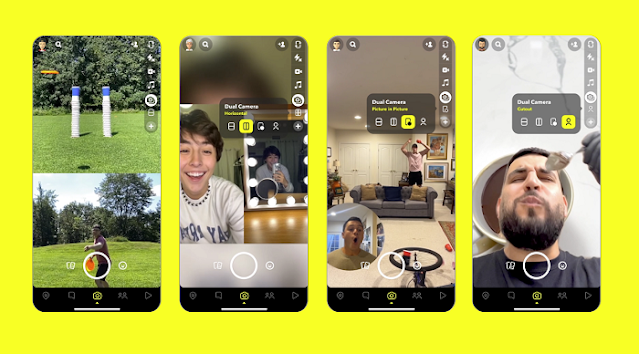
Snapchat has released a new Dual Camera option, which it has imitated from the French social media app BeReal.


The Dual Camera functionality allows for recording videos or taking photos that are captured by the front and back-facing cameras at the same time. It supports several output formats including vertical, horizontal, picture-in-picture, and cut-out.


While Instagram also developed its own version of the feature, Snapchat’s primary intention behind the launch is to provide users with more creative opportunities and trends. The company originally previewed the option as a part of its Director Mode, which contains more advanced editing tools for creative purposes.

Snapchat Rolls Out a Dual Camera Functionality

Photographic identification of whales

Photographic identification is the most convenient and non-invasive tool to learn bout the different types of whales in the ocean. The factors such as the high mobility of almost every species in the ocean and the large proportion of migration done by whales make it difficult to study them.

Photographic identification of whales #infographic


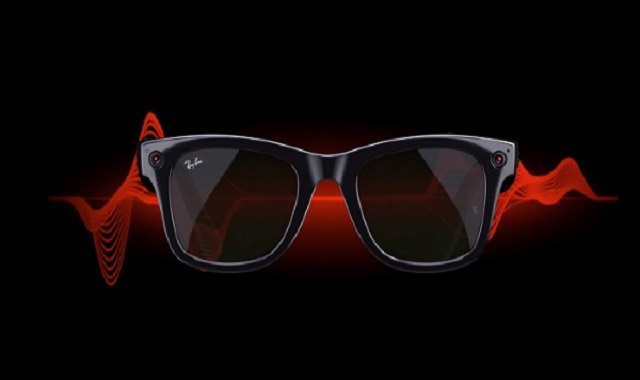
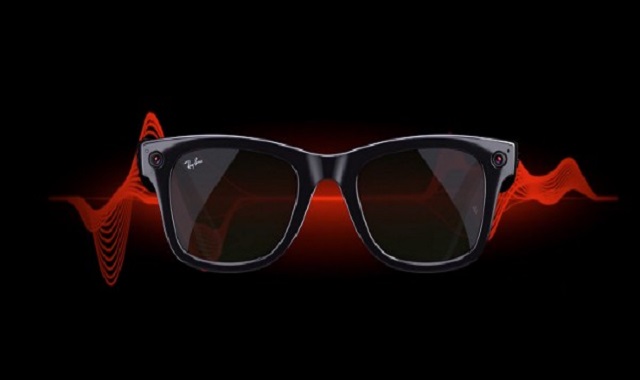
Facebook has partnered with Ray Ban to launch its first ever smart glasses in a variety of trendy styles. They go by the name of “Ran Ban Stories” and are priced at $299.


The glasses are based on three distinct traditional designs of Ray Ban, including the most popular one called Wayfarer. Facebook has built a multi-camera hub into the frame of the glasses, with which users can record or capture anything that they see while wearing them. There is a button on the top of the arm of the device, tapping which starts the recording. It provides a fun and easy way to capture live experiences.


Facebook Launches New Smart Glasses in Collaboration with Ray Ban


Sony just made an announcement about its new mirrorless camera, which happens to be its most advanced one to date. It costs $6,500 and is called Alpha 1. The camera comes with a new 50.1-megapixel full-frame sensor and can shoot continuous photos at 30 images per second. Moreover, it can record 8K video at 30fps. According to Sony, the shipping of its new camera will start from March.


Since Alpha 1 is priced significantly above mirrorless cameras of other companies like Canon and Nikon, Sony assures its customers that Alpha 1 is the most technologically advanced and innovate product of the company.


The camera’s buffer is capable of shooting up to 155 full-frame compressed RAW images or 165 full-frame JPEG images at up to 30 frames per second with its electronic shutter, while maintaining full AF and AE tracking performance. This sounds like a dream come true for sports and action photographers.

Sony Announces its New, Most Technologically Advanced Mirrorless Camera ‘Alpha 1’


Google has removed the astrophotography capabilities within the camera lens of Pixel 5 and 4a 5G. The feature has been taken away with Google Camera’s 8.1 update.


This special feature was a selling point of the Pixel 4 and was also available on the regular and telephoto cameras. It was also added to the 4a 5G and 5 with their new wide-angle lenses.


The feature allowed users to take photos of the night sky by pointing their phone up and keeping it still by balancing it on an object or setting it up on a tripod. 

Google’s Wide-Angle Astrophotography Feature is Gone from Pixel Phones’ Camera


PhotoRoom, a French startup is launching its utility photography app for Android, that it has been working on. The app is supposed to offer several useful photography tools like removing the background from a photo, swapping it for another background, and tweaking a photo. The company has also already started working on iOS.


PhotoRoom has been particularly used by influencers and people as a creativity platform, who resell clothes and fashion items. Accessing the app requires a subscription of $9.49 per month or $46.99 per year.

PhotoRoom is Launching its Android Photography App


The right lens for studio photography

Photography is a very vast field. Many things go into the process of photography. There is shutter speed, aperture, ISO speed, and much other photography jargon that play a huge role in the outcome of a single photo. However, the one main thing that remains consistent and plays a really big role is the camera lens.

The right lens for studio photography #infographic

A guide for image print resolutions

When you are about to bring your digital work into the physical world, there are certain barriers you have to come across such as printers. There are a lot of times that we want to print an image but it looks very odd. This happens when the image is not printed on the right resolution.

A wrong resolution can drastically change the outcome of the print. Often times, the quality of the image is significantly downgraded when it is printed out but it looks fine on your computer or on the web. There is always a conflict between the compute5r image resolution and the maximum print size. Someone, who doesn’t have an idea about such things, can easily mess up the image print.

A guide for image print resolutions #infographic


With the growing use of mobile phone cameras for taking selfies, a variety of fun and unique beauty filters are being introduced in different social apps. Google recently explored the impact of filtered selfies on people's wellbeing by conducting studies and speaking with child and mental health experts. Through the research, the company found out that there is a negative impact of default filters on mental wellbeing. For this reason, Google has created guidelines on control, transparency and design language relating to filtered photos. 


In a blogpost, Google revealed its new people-centered guidelines that will let users choose if and when their appearance is changed in pictures. This means that the face retouching settings will be off by default. 

Google Introduces Guidelines for Control and Transparency for Filtered Selfies

Subscribe Our Newsletter