Visualistan: Hacking -->

    Social Items


Instagram has launched a new recovery center that is aimed at helping users retrieve their profiles after being logged out of their accounts due to hacking, forgetting password, losing access to two-factor authentication or account being disabled.


The recovery center can be accessed from https://www.instagram.com/hacked/, which provides a step-by-step guide of the process of getting an account back. In addition to that, users will also be able to refer to any two of their Instagram friends, so as to confirm their identity in case of being locked out of their account.
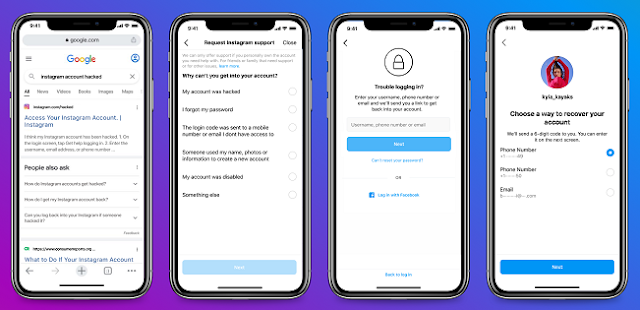


Instagram Rolls Out New Security Features Including a Recovery Center to Help Retrieve Locked Accounts


Twitter has introduced a new warning label for tweets containing content “obtained through hacking.” News stories that are detected as based on hacks and leaked documents show this new label. However, users have already figured an easy way to hack a URL together and make it appear on any tweet.


For instance, if you share the URL of a story with the new label, it will generate the warning. Unfortunately, you can easily trick Twitter into flagging tweets with this new warning by using a specially crafted link to a genuine URL along with the flagged one.


Twitter Users have Discovered the Hack for the New Warning Label


A recent PayPal phishing attack is attempting to steal users’ account credentials and other sensitive information that can be used for identity theft.


The phishing campaign is actively being carried out in the form of text messages that are pretended to be from PayPal, telling users that their account has been permanently limited and asking them to click on a link to verify their account. Usually when a suspicious or fraudulent activity on an account is detected by PayPal, the account’s status is set to "limited," which puts temporary restrictions on activities such as withdrawing, sending, or receiving money.


By clicking on the link given in the phishing message, users are taken to a phishing page where they are prompted to log in to their PayPal account. Logging in on the phishing page would send the users’ PayPal credentials to the attackers and the phishing page would even try to collect further information from users, such as their name, date of birth, address, bank details, and more.


The collected information can then provide an opportunity to attackers for identity theft and they can even gain access to other accounts using that information.

Active Phishing Campaign on PayPal Attempting to Steal Users’ Account Credentials

Increased reports of Hacking in the Video gaming world

Video gaming is one of the few things in the world that people can never turn their backs on. With the video gaming market on the rise, it has become impossible for people to subsidize its use because as long as upgrades are being processed, there is no going back from this oddly satisfying world of gaming. Apart from its benefits, there are also a few elements that cannot be overlooked at any cost. The element of Hacking that comes with exposure to video gaming is extremely vital for the industry as it has the power to feed on data and information of users provided in the games.

Increased reports of Hacking in the Video gaming world #infographic

Donald Trump downplayed the severity of SolarWind’s hack via his Tweets

US faced one of the biggest cyberattacks in its history in which multiple US agencies were the target, and the SolarWind attack is suspected to be a global effort. The attack was first reported by FireEye company, followed by the reports from other companies. The attack broke out on December 8th, and the number of victims has reached 18,000 out of total 300,000 customers.

Donald Trump downplayed the severity of SolarWind’s hack via his Tweets

All about Social Engineering assaults

Manipulating people psychologically in order to divulge their information or take malicious actions is known as Social Engineering Attack. These assaults have become pretty common over the years, and companies have not found a ‘stop sign’ yet against these criminals. In fact, hackers have come up with the latest and innovative ways to invade privacy and steal credentials. There are numerous ways of cyberattacks that the hackers follow; unfortunately, no one can spot the hackers while they are stealing the information and get to know when they have done their activity.

All about Social Engineering assaults #infographic


On Wednesday, some world-famous artists including Dua Lipa and Rana Del Rey’s Spotify pages got hacked by an apparent Taylor Swift fan who replaced the celebrities’ images with his own.  


The attacker who disclosed his name as ‘'Daniel’' further asked people to add him on Snapchat and also posted messages about Donald Trump and Taylor Swift, like ‘'Trump 2020’' and "Best of all shout out to my queen Taylor Swift". 


This action was bizarre, and Spotify’s security has been questioned. Spotify was quick to notice the behavior and reversed the changes that were made to the pages, which now appear to be back to normal.  

Some Artists’ Spotify Pages got Hacked by a Taylor Swift Fan Apparently

Hackers stole the personal data of 350,000 Capcom customers

Japanese video game developer company, Capcom, experienced a ransomware hack due to which the hackers successfully stole confidential data of the company and its customers' personal information. The company said that the hacked information includes names, dates of birth, addresses, email addresses, passport information, phone numbers, and a lot more. The hackers not only stole the customers' data but also the company's very private information regarding its games.

Hackers stole the personal data of 350,000 Capcom customers


Facebook users have recently become victim to fraudulent activity on the platform, which is stealing users’ data through the display of advertisements.  


Facebook discussed the malware attacks faced by its platform, at the 2020 security conference held at the Virus Bulletin. One of the hacker groups named Silent Fade has been reported to steal data of users over $4 million ransom. 


The attackers successfully exploited users after several attempts by accessing their passwords and other important stored data and eventually hacking their accounts. The hacker group manipulated users through bugs and links, followed by using their bank accounts linked with Facebooks to buy ads on the platform.  

Attackers on Facebook are Hacking Accounts Using Facebook Advertisements

Covid-19 vaccine makers attacked by hackers from North Korea and Russia

In one of its blog posts, Microsoft said that some hackers from Russia and North Korea have targeted companies that are currently working on the development of a vaccine against Covid-19. According to the blog post, seven prominent pharmaceutical companies and scientists from Canada, the USA, India, South Korea, and France. The hackers have their eye on those makers whose vaccines are in different clinical trials.

Covid-19 vaccine makers attacked by hackers from North Korea and Russia


It has been discovered through a research conducted at the University of Texas, San Antonio and University of Oklahama, that hackers may be able to guess passwords and other important details of Zoom users by analyzing their body positions and language while on a video conference call.  


According to the research, hackers could study users’ specific body movements such as their shoulder movements while they type and detect keystrokes by analyzing their upper arm movements with as much as 93% accuracy.  

Hackers can Access Zoom Users’ Passwords by Analyzing their Body Movements


The cost of a computer virus

Computer viruses have been around for a long time. They are a piece malware or a spyware that malicious people put in your computer. Getting a virus on your computer is really annoying and you have to take a quick action to remove it before it causes any damage. Sometimes, these viruses are an easy fix but sometimes they aren’t. If you have had a virus get out of your hands and infect your computer then you are one of the 16 million Americans who have had the same problem in the last two years.


The cost of a computer virus #infographic


Android devices have once again been attacked by a new malware, affecting 17 of the apps on Google's Play Store. The new malware is known as the Joker malware and it is able to access messages, contact lists, device information, and most dangerously, it is able to have users automatically sign up to premium wireless application protocol (WAP) services.  


The malware is able to hack devices by using a combination of code tweaks, execution method variation, and changing how it downloads the payload, which results in it being able to access important device information and manipulate sign-ups to WAP services.


Google took action against the threat by taking down the ''infected'' apps from Play Store and also disabled them on devices where they are already installed. 

New Malware Affects 17 Apps on Play Store


It has been noticed by CheckPoint in a recent study that Instagram's app for Android has a bug that is allowing hackers to hack the camera and headphone jack of Android phones. Attackers can get control of the entire device by simply sending images crafted to the users of Android phones. 


Not only that, but hackers can also cause variations in the users' Instagram profiles. Once users' privacy is exploited, they become victim to a number of other issues revolving around their reputation on social media.

Bug in Instagram's App for Android Enables Attackers to Get Control over Users' Smartphones

SMS Scams and how to identify them

Our world has changed quite a lot in the last two decades. With technology and the internet, everything is connected. This has also given a rise to scammers who try to scam people for money. Unwanted calls, messages, emails are all tactics used by scammers. They bombard people with this so that they can falsely extract information or money from them.

Most people identify the scammers and ignore them but few of them don’t recognize them and those poor people are usually the target. Scammers take advantage of a person’s naivete and scam them for money. During the pandemic, the number of scamming cases rose to an all-time high. This is due to the fact that a person is most vulnerable during a crisis.

SMS Scams and how to identify them #infographic

A new teenager suspected to be a part of Twitter attack

Back in July, Twitter faced one of the biggest hacks in its history, where a group of attackers invaded the private Twitter accounts of high profile for a bitcoin scam. These hackers posted Tweets regarding bitcoin funds, and each of the posts had the same account number. The matter was recognized earlier, and investigations were started immediately.

Three attackers were initially found to be the people behind the entire incident; however, the New York Times reported today that one more 16-year-old teenager from Massachusetts had been suspected. The new member of the gang is apparently the youngest one, and the group is now totaled as consisting of four individuals.

Well, it has not been discovered yet who was the one having an internal connection with Twitter; however, the 17-year-old teen Graham Clark is assumed to be the mastermind behind the entire plan. Graham has now also been charged with 30 felonies. Other members of the gang including, 22-year-old Nima Fazeli from Orlando and 19-year-old Mason John Sheppard from the UK, have already been announced their punishments.

A new teenager suspected to be a part of Twitter attack


We are growing more and more dependent on mobile devices than ever before. We used to rely on computers but mobile devices are more compact and convenient to use. No doubt mobile devices have the countless benefits in both professional and personal world but they also have the tendency to expose sensitive data to the wrong personnel.

Cyber-crimes, hacking and identity theft are much more common in today’s world than ever before and these threats are real. They should be taken seriously. Previously, we have had strong threat defense for our personal computers, desktops and laptops. Mobile devices never received such traction despite the growing need of such threats.

The Need of Mobile Threat Defense #infographic

The Brands Most Impersonated for Phishing Attacks

Phishing is one of the most common types of hacking. These phishing e-mails have links which when clicked, lead to shady and untrustworthy websites. It is via those websites that hackers try to retrieve your information. Not every Internet user has the sense or experience to detect these shady scam emails. The one reason that it can be hard to detect such emails at one glance is that they usually have usernames that are similar to the entity they are impersonating.

Say, if someone is new to the Internet and receives an email allegedly from Nokia, they might fall into the trap if they don't examine the e-mail address carefully and find 'Nokkia' instead of 'Nokia' written there. Big brands do not jumble up or fidget with the letters of their brand names, so that's a clear trap which gets overlooked by gullible people or those users that get carried away by what the e-mail contains, for instance, it can be a lottery.

The Brands Most Impersonated for Phishing Attacks #Infographic

Three hackers charged for breaching Twitter accounts

On July 15th, 2020, Twitter faced a huge privacy issue in history were 130 accounts were hacked. The attackers initiated a massive bitcoin scam, which was very soon noticed by Twitter, FBI, and other agencies. Since then, an investigation has been operational, which led the security agencies to three suspected hackers. Amongst the three hackers, one was a teenage boy aged 17 years Graham Clark, a resident of Tampa, Florida. He is believed to be the 'mastermind' behind the entire attack and is also the one who was successful enough to enter the Twitter accounts of Barack Obama, Bill Gates, Joe Biden, Kanye West, Elon, Apple, and more.

After Clark's arrest, two more hackers named Nima Fazeli in Orlando and Mason Sheppard in the UK were arrested, Fazeli aged 22 years and Sheppard aged 19 years. Both of the hackers use aliases as 'Rolex' (Fazeli ) and 'Chaewon' (Sheppard). The FBI confirms that both individuals are in custody and being interrogated. An unidentified minor from California also confirmed to the agencies that they sold the access of Twitter accounts to Chaewon. Whereas, Clark said that he got access to Twitter's internal tools with the help of a Twitter employee who worked in the IT department of Twitter.

Three hackers charged for breaching Twitter's private accounts


A hacker that goes by the name of  ShinyHunters has offered a massive 200 million stolen data records on sale on the dark web. The data is fresh to the market and, thus, quite valuable. Nobody had heard of ShinyHunters until his offer went viral. The hacker has, ever since, become a well-known data breach broker within weeks. 


There is no solid evidence that suggests the exact amount that ShinyHunters has made from their hacking spree. It is, however, known that some of the breached databases were being offered on the dark web worth $100,000 each.


According to some reports, the going rate for a ShinyHunters database dump was between $1,500 and $2,500 on an average. 

Hacker Gives Away 200 Million Stolen Data Records on Dark Web

Subscribe Our Newsletter