Visualistan: Hacking -->

    Social Items


Instagram has launched a new recovery center that is aimed at helping users retrieve their profiles after being logged out of their accounts due to hacking, forgetting password, losing access to two-factor authentication or account being disabled.


The recovery center can be accessed from https://www.instagram.com/hacked/, which provides a step-by-step guide of the process of getting an account back. In addition to that, users will also be able to refer to any two of their Instagram friends, so as to confirm their identity in case of being locked out of their account.
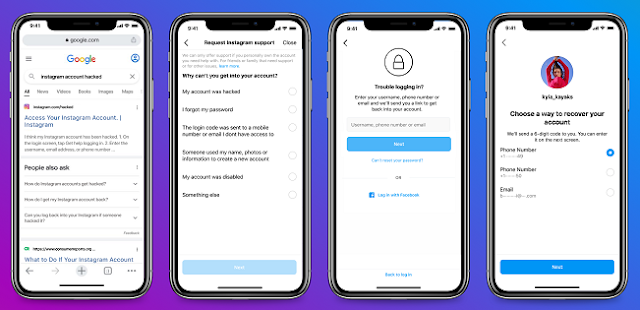


Instagram Rolls Out New Security Features Including a Recovery Center to Help Retrieve Locked Accounts


Twitter has introduced a new warning label for tweets containing content “obtained through hacking.” News stories that are detected as based on hacks and leaked documents show this new label. However, users have already figured an easy way to hack a URL together and make it appear on any tweet.


For instance, if you share the URL of a story with the new label, it will generate the warning. Unfortunately, you can easily trick Twitter into flagging tweets with this new warning by using a specially crafted link to a genuine URL along with the flagged one.


Twitter Users have Discovered the Hack for the New Warning Label


A recent PayPal phishing attack is attempting to steal users’ account credentials and other sensitive information that can be used for identity theft.


The phishing campaign is actively being carried out in the form of text messages that are pretended to be from PayPal, telling users that their account has been permanently limited and asking them to click on a link to verify their account. Usually when a suspicious or fraudulent activity on an account is detected by PayPal, the account’s status is set to "limited," which puts temporary restrictions on activities such as withdrawing, sending, or receiving money.


By clicking on the link given in the phishing message, users are taken to a phishing page where they are prompted to log in to their PayPal account. Logging in on the phishing page would send the users’ PayPal credentials to the attackers and the phishing page would even try to collect further information from users, such as their name, date of birth, address, bank details, and more.


The collected information can then provide an opportunity to attackers for identity theft and they can even gain access to other accounts using that information.

Active Phishing Campaign on PayPal Attempting to Steal Users’ Account Credentials

Increased reports of Hacking in the Video gaming world

Video gaming is one of the few things in the world that people can never turn their backs on. With the video gaming market on the rise, it has become impossible for people to subsidize its use because as long as upgrades are being processed, there is no going back from this oddly satisfying world of gaming. Apart from its benefits, there are also a few elements that cannot be overlooked at any cost. The element of Hacking that comes with exposure to video gaming is extremely vital for the industry as it has the power to feed on data and information of users provided in the games.

Increased reports of Hacking in the Video gaming world #infographic

Donald Trump downplayed the severity of SolarWind’s hack via his Tweets

US faced one of the biggest cyberattacks in its history in which multiple US agencies were the target, and the SolarWind attack is suspected to be a global effort. The attack was first reported by FireEye company, followed by the reports from other companies. The attack broke out on December 8th, and the number of victims has reached 18,000 out of total 300,000 customers.

Donald Trump downplayed the severity of SolarWind’s hack via his Tweets

All about Social Engineering assaults

Manipulating people psychologically in order to divulge their information or take malicious actions is known as Social Engineering Attack. These assaults have become pretty common over the years, and companies have not found a ‘stop sign’ yet against these criminals. In fact, hackers have come up with the latest and innovative ways to invade privacy and steal credentials. There are numerous ways of cyberattacks that the hackers follow; unfortunately, no one can spot the hackers while they are stealing the information and get to know when they have done their activity.

All about Social Engineering assaults #infographic


On Wednesday, some world-famous artists including Dua Lipa and Rana Del Rey’s Spotify pages got hacked by an apparent Taylor Swift fan who replaced the celebrities’ images with his own.  


The attacker who disclosed his name as ‘'Daniel’' further asked people to add him on Snapchat and also posted messages about Donald Trump and Taylor Swift, like ‘'Trump 2020’' and "Best of all shout out to my queen Taylor Swift". 


This action was bizarre, and Spotify’s security has been questioned. Spotify was quick to notice the behavior and reversed the changes that were made to the pages, which now appear to be back to normal.  

Some Artists’ Spotify Pages got Hacked by a Taylor Swift Fan Apparently

Hackers stole the personal data of 350,000 Capcom customers

Japanese video game developer company, Capcom, experienced a ransomware hack due to which the hackers successfully stole confidential data of the company and its customers' personal information. The company said that the hacked information includes names, dates of birth, addresses, email addresses, passport information, phone numbers, and a lot more. The hackers not only stole the customers' data but also the company's very private information regarding its games.

Hackers stole the personal data of 350,000 Capcom customers


Facebook users have recently become victim to fraudulent activity on the platform, which is stealing users’ data through the display of advertisements.  


Facebook discussed the malware attacks faced by its platform, at the 2020 security conference held at the Virus Bulletin. One of the hacker groups named Silent Fade has been reported to steal data of users over $4 million ransom. 


The attackers successfully exploited users after several attempts by accessing their passwords and other important stored data and eventually hacking their accounts. The hacker group manipulated users through bugs and links, followed by using their bank accounts linked with Facebooks to buy ads on the platform.  

Attackers on Facebook are Hacking Accounts Using Facebook Advertisements

Covid-19 vaccine makers attacked by hackers from North Korea and Russia

In one of its blog posts, Microsoft said that some hackers from Russia and North Korea have targeted companies that are currently working on the development of a vaccine against Covid-19. According to the blog post, seven prominent pharmaceutical companies and scientists from Canada, the USA, India, South Korea, and France. The hackers have their eye on those makers whose vaccines are in different clinical trials.

Covid-19 vaccine makers attacked by hackers from North Korea and Russia


It has been discovered through a research conducted at the University of Texas, San Antonio and University of Oklahama, that hackers may be able to guess passwords and other important details of Zoom users by analyzing their body positions and language while on a video conference call.  


According to the research, hackers could study users’ specific body movements such as their shoulder movements while they type and detect keystrokes by analyzing their upper arm movements with as much as 93% accuracy.  

Hackers can Access Zoom Users’ Passwords by Analyzing their Body Movements


The cost of a computer virus

Computer viruses have been around for a long time. They are a piece malware or a spyware that malicious people put in your computer. Getting a virus on your computer is really annoying and you have to take a quick action to remove it before it causes any damage. Sometimes, these viruses are an easy fix but sometimes they aren’t. If you have had a virus get out of your hands and infect your computer then you are one of the 16 million Americans who have had the same problem in the last two years.


The cost of a computer virus #infographic

Subscribe Our Newsletter