Visualistan: Data -->

    Social Items

Building Financial Opportunity with Alternative Data

Roughly 76 million Americans face challenges accessing credit.  This is because they are either thin files, meaning that they have four or less credit accounts on their file, or they are credit invisible, which means they do not have a traditional credit file.

Building Financial Opportunity with Alternative Data #Infographic


A 2020 lawsuit put forth by Google account holders resulted in filing of a proposed class action settlement on Monday in a California federal court. The lawsuit accused Google of illegal tracking of users’ activity in Incognito mode. In the filed settlement, Google has therefore declared that it will destroy all the billions of records of web browsing data of its users collected from its private browser.


In addition to this, the proposed settlement requires Google to provide greater transparency regarding its data collection processes in Incognito mode and how the company will be putting limits on these processes in the future. Google will also need to de-identify any data that is not entirely deleted. Lastly, Google has also agreed to let users block third-party cookies by default in Incognito mode, so as to prevent tracking on outside websites as they browse privately.

Google Agrees to Destroy User Data Collected in Incognito Mode in a Proposed Settlement


Google is bringing a major change to Maps – users’ location history will now be stored locally on their devices instead of in the cloud. This is to prevent personal data from being accessible to law enforcement.


Law enforcement can collect data from tech companies on mobile phones that have passed through a certain area during a specific time, as a result of ‘geoface warrants.’ This makes anyone present at an alleged crime scene a potential suspect and puts all such people’s privacy at risk, hence the controversy around these warrants.


The update in Maps is specifically being applied within the Timeline feature, that keeps track of users’ location history and this information is stored in the Cloud. After the change, the data will instead be stored in users’ devices. Both Android and iOS users of Google Maps will receive a notification informing them about the update as it gradually rolls out.

Google to Prevent Users’ Data in Maps from Being Accessed by Law Enforcement


The popular programming language Python will now be accessible in Excel. Available directly in the Excel ribbon, Python can be used to conduct advanced data analysis, including manipulating and exploring data. The insights can be further refined using Excel’s own formulas, charts and PivotTables.


Python will be available in Excel as part of the software’s built-in connectors and Power Query, which means that users won’t need to separately download a software or set up an add-on to access it. Popular Python libraries like pandas, statsmodels, and Matplotlib will also be accessible in Excel.


Additionally, users will be able to view their Python data within the grid of their Excel spreadsheet, as a result of a new PY function. All Python calculations will take place in the Microsoft Cloud and the results will return to the Excel spreadsheets.

Microsoft is Launching a Python Integration in Excel


Google has introduced new privacy-focused APIs that will go into effect on 24th of July. The news comes after the public release of Chrome 115.  As a result of new APIs being applied, third-party cookies will be ultimately eliminated from Chrome by the third quarter of 2024.


More specifically, the change will come as Google’s ‘Privacy Sandbox toolkit’ for Chrome will be gradually activated for developers, hence replacing third-party cookies with API alternatives that grant better security.


Google plans to do an early test of the Privacy Sandbox tools with advertisers later this year, as well as disable third-party cookies for 1% of Chrome users in the first quarter of next year.

Third-Party Cookies to be Phased Out on Chrome in Q3 of 2024


In alignment with the changes in EU privacy laws and broader industry shifts, TikTok is updating its data usage policies. These updates mainly revolve around data that TikTok collects from younger users on its platform.


More specifically, TikTok has developed these policy updates in line with the new EU Digital Services Act (DSA) that states new laws around the use of data to target young users. The DSA is going to be implemented in the coming months. “Starting today, we're restricting the types of data that can be used to show ads to teens by region,” says TikTok.


TikTok’s revised ad policy includes the following:

  • Removal of personalized ads on TikTok based on off-app activities for users aged 13 to 15 in the US.
  • Removal of personalized ads on TikTok based on off-app activities for users aged 13 to 17 in the European Economic Area, United Kingdom, and Switzerland


Considering that two-thirds of teens in the US are users of TikTok, the changes in TikTok’s data usage policies will have a considerable impact on how advertisers run their campaigns on the platform to target the population.

TikTok Announces Revised Ad Policy Around Data of Teen Users, and New Tools for Data control and Transparency

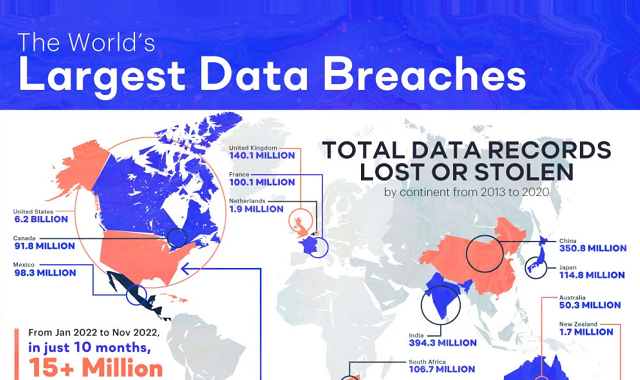
Get the Details on Global Data Loss

Unfortunately, data loss is common, and has been for centuries.  Globally, 15+ million data records were lost or stolen between January 2022 and November 2022.  While data breaches happen in every country, 64% of data breaches occur in the US, making it the leading victim.

Get the Details on Global Data Loss #Infographic


To help users understand the purpose and usage of all the security and safety tools in the app in one place and enhance their in-app experience, WhatsApp has created a new Security Hub mini site. The hub provides an overview of WhatsApp’s default safety and security features, as well as control options that significantly contribute to users’ account and data security.


Some of WhatsApp’s integral security features include default privacy, automatic spam detection, and proactive security alerts.


The mini site educates users on how to avoid scamming, spamming, and malicious acts like data theft that commonly occur across the platform. “Malicious actors and hostile states routinely challenge the security of our critical infrastructure,” says the company.

WhatsApp Launches a New ‘Security Hub Mini Site’ to Guide Users through All Security and Safety Tools Available in the App

The Challenges of Cloud Monitoring

Cloud monitoring is essential for businesses that rely on cloud tools, which are now used more than ever. However, according to recent reports, 79% of organizations face widening visibility gaps in their cloud infrastructure, making it difficult to track what's happening on cloud-based platforms. Additionally, most cloud monitoring tools focus on one specific service, forcing data teams to gather and analyze information across different silos. This lack of visibility leads to reduced functionality, security risks, poor migration support, and delays in troubleshooting application and network performance.

The Challenges of Cloud Monitoring #Infographic

Air Pollution Has Become a Global Health Threat


Air pollution is considered to be extreme environmental health hazard to humankind, becoming a reason for over six million deaths a year and an economic cost that is equal to over $8 trillion dollars. This analysis is according to the World Air Quality Report 2022 released on Tuesday by IQAir, a Swiss air quality technology company. The analysis revealed that out of a surveyed 131 countries, regions and territories, only 13 resulted in meeting World Health Organization air guidelines of annual PM2.5 concentrations at or below 5 μg/m3 in 2022, many of which were in Oceania.

Air Pollution Has Become a Global Health Threat #Infographic


Mental health platform Cerebral claims to have accidentally shared its user data with third-party advertisers including big companies like Meta, Google, TikTok and others. The leaked data contains significant details of Cerebral’s users, including their names, phone numbers, insurance information, email addresses, IP addresses, birth dates, appointment dates, treatment information, and more. 


Cerebral further revealed that the accident could have possibly resulted from the tracking tools that it has been using, and more specifically the bits of code embedded in its app from the third party advertisers. These have allowed Cerebral to measure how its users engage with ads on its platform, while giving advertising platforms access to user information.

Cerebral Confirms Having Accidentally Exposed Private User Data to Advertising Companies


TikTok has partnered with Dentsu Digital, the Japanese international advertising agency, to provide a privacy-friendly alternative to cookie tracking. Through the new tracking process called ‘Digital X,’ advertisers on TikTok will be able to track user data via TikTok’s server-to-server interface Events API integrated into Dentsu Digital’s X-Stack.


More specifically, the X-Stack Connect platform works by enabling advertisers to measure users’ online behaviours on websites using server access logs with user consent. This includes actions like website visits, logins, and form entry information.

TikTok Introduces New Data Tracking System: Digital X

Subscribe Our Newsletter