Visualistan: Teens -->

    Social Items


Instagram has consistently worked on improving the in-app experience for its teen users, ensuring a safe social space for them to engage with others. Recently, Instagram has launched new content recommendation controls that reduce teen users’ exposure to sensitive content, such as involving the topic of self-harm.


Instagram has taken into consideration the potential negative impact of a complex topic like self-harm on teens’ mental health. “We will start to remove this type of content from teens’ experiences on Instagram and Facebook, as well as other types of age-inappropriate content,” says the social media company. Currently, there is already limited recommendations of self-harm related content within Reels and Explore. Moving forward, these restrictions will also be applied to Feed and Stories, even including content from accounts that teen users follow.


Linked with this addition is another important safety restriction that would inform Instagram if a teen user searched for terms similar to suicide, self-harm, and eating disorders. This would enable Instagram to redirect the user to official help services when they search for such terms. Additionally, specific search results that are detected as potentially triggering will be entirely hidden from the users.

Instagram is Rolling Out New Protective Measures against Sensitive Content for Teen Users


In alignment with the changes in EU privacy laws and broader industry shifts, TikTok is updating its data usage policies. These updates mainly revolve around data that TikTok collects from younger users on its platform.


More specifically, TikTok has developed these policy updates in line with the new EU Digital Services Act (DSA) that states new laws around the use of data to target young users. The DSA is going to be implemented in the coming months. “Starting today, we're restricting the types of data that can be used to show ads to teens by region,” says TikTok.


TikTok’s revised ad policy includes the following:

  • Removal of personalized ads on TikTok based on off-app activities for users aged 13 to 15 in the US.
  • Removal of personalized ads on TikTok based on off-app activities for users aged 13 to 17 in the European Economic Area, United Kingdom, and Switzerland


Considering that two-thirds of teens in the US are users of TikTok, the changes in TikTok’s data usage policies will have a considerable impact on how advertisers run their campaigns on the platform to target the population.

TikTok Announces Revised Ad Policy Around Data of Teen Users, and New Tools for Data control and Transparency


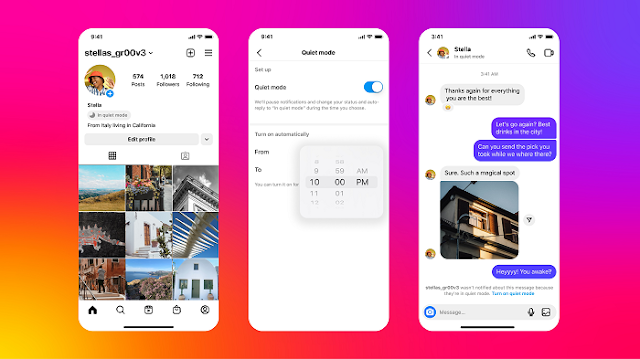
Instagram is rolling out three new functionalities to the app. These include Quiet Mode, the ability to hide recommendations, and new control options for parents.


The Quiet Mode is designed to enable users to take a break from the app by switching off all notifications and enabling the auto responding system in DMs. Enabling the option will also add a ‘quiet mode’ notifier to users’ profile status. The Quiet Mode time can be manually customized. Instagram also adds that after the functionality is turned off, a summary of notifications will be provided to users to let them know what they missed.


According to Instagram, the Quiet Mode feature was created after teen users on the app reported that they were looking for ways to focus, such as at night, during study hours, and at school. Therefore, while all users will be able to use the Quiet Mode, teens in particular will be prompted to try the functionality when Instagram detects that they may be spending excessive time on the app.

Instagram Launches ‘Quiet Mode’ and Other New Options to Improve In-App Experience


Meta has expanded its measures for the protection of underage users on Facebook Dating in the US. This means that users aged under 18 years will not be allowed to sign up for and access Facebook Dating.


This age verification tool, however, is not a regular one. It is powered by digital identity company Yoti, with whom Meta has been working since June of this year. Yoti’s systems are equipped with training on a large amount of global data of anonymous images belonging to a diverse range of people. As a result, the company can almost accurately determine the ages of people using video selfies.


According to Meta, it will launch the tool across its apps including Facebook, Instagram and Facebook Dating. During the test of the tool on Instagram, Meta discovered that about four times as many people were more likely to complete its age verification requirements as their attempts to edit their age from under 18 to over 18. This equated to “hundreds of thousands of people being placed in experiences appropriate for their age.”

Meta Expands its ID-Based Age Verification Tool to Facebook Dating in the US


Meta has announced new privacy updates for better protection of people aged below 16 years on Facebook. These include stricter privacy controls that allow them to limit what people view on their profiles, hide tagged posts, as well as limit comments from non-friends.


Meta had earlier launched similar control settings on Instagram as well, where users aged below 16 years had their accounts automatically set to private.


Although these settings would practically not result in complete safety, they could still facilitate younger users in choosing who can interact with them, hence giving them more authority in managing their profiles and ensuring awareness for self-protection.


Additionally, Meta is testing another safety option that limits children’s exposure to adult-owned accounts that appear suspicious. Meta defines a ‘suspicious account’ as one that “may have recently been blocked or reported by a young person, for example.” These accounts will be prohibited from sending messages to younger users and will also be removed from their recommendations.

Meta is Ensuring Improved Protection of Young Users from Potential Exploitation Via New Safety Tools on Facebook


Snapchat’s new Family Centre is providing parents with monitoring tools to supervise their children’s activities on the app, without eavesdropping their private conversations, and understand the ways in which kids and teens are engaging across the social platform.


Speaking about the update, Snapchat announced, “In the coming weeks, we will add a new feature that will allow parents to easily view new friends their teens have added.”


The social company further assures parents that they will be able to report any accounts that they find concerning in relation to Snap’s Trust and Safety teams, without informing their child about them, so as to keep any potential unwanted attention away from their children.

Snapchat Introduces Monitoring Controls for Parents Via Family Centre


Meta has taken a new initiative towards the safety of younger audience with regard to unsafe, intimate activities that teen users could be engaging in over social media. The company has released a guide on how parents could have discussions about these practices with their teen children and offer them their advice.


One of the key elements of discussion that Meta has focused on is telling teens that sending or receiving intimate images isn’t something that everyone does, which suggests being cautious when receiving inappropriate images.

Meta’s Latest Guide is Helping Parents Have Conversation with their Teen Children About Exchange of Intimate Content on Social Media

American Teens and Addiction

The “war on drugs” began 40 years ago, but the levels of trafficking and addictions are still high. Aside from illegal drugs, the misuse of prescription medicine is on the rise. 


The wide spread and accessibility of drugs contribute to substance abuse among the young generation. Experimenting with substances in the teenage years can foster long-term use and addiction later in life. Statistics included in our infographic prove this fact. 

American Teens and Addiction #Infographic


Instagram is introducing some new tools in an effort to ensure better safety for its young user community. The company has published a new Parents Guide after collaborating with The Child Mind Institute and ConnectSafely in the US. The guide includes latest safety tools, privacy settings, and conversation starters to navigate discussions between parents and teens.


Another step that Instagram has taken is to understand its users’ real age, as a lot of times young people lie about their date of birth when signing up for an account. To prevent this from happening, the company is developing new artificial intelligence and machine learning technology to help keep teens safer.


With one of its new age-safety related features, Instagram is attempting to protect teens from unwanted contact from adults by preventing adults from sending messages to people under 18 who don’t follow them. When an adult tries to message a teen who doesn’t follow them, they will get a notification saying that DM’ing them isn’t an option.

Instagram is Bringing New Features for the Safety of its Young User Community

TikTok adds more privacy for young teens’ accounts by default

The most widely used short-video application, TikTok, has worked on improving the privacy of the teenagers’ accounts on the platform. Every teenager aged between 13 and 15 who signs up on the application, will have their account secured better than before that too, by default. The new privacy settings will only allow the friends of the user to view and comment on the videos moreover; teenage accounts won’t be suggested to other users. The company will also suspend every user to comment on videos by these accounts even if their profile is public.

TikTok has a Duet and Stitch feature through which users can recreate, respond, or repost videos posted by another user. For under 16 profiles, the Duet and Stitch feature will also be disabled. In addition, users under the age of 17 won’t be able to download the videos. The Duet and Stitch feature will be restricted to the friends of users aged between 16 and 17.

TikTok adds more privacy for young teens’ accounts by default


TikTok introduced a new feature of Family Pairing this year, the aim of which was to provide a safe space for teenagers to create content, by allowing parents to link their TikTok account with their teen’s. The company is now expanding this feature to allow parents more control over regulating their teens’ activities on the platform. 


The new tools offered in Family Pairing include Search (new), Screen Time Management, Restricted Mode, Comments (new), Discoverability, Liked Videos (new), and Direct Messages.  


 With Search, parents can decide whether their teen can search for content, hashtags, users, or sounds. The Screen Time Management Tool offers the parents the ability to set the time their teen spends on the platform each day. With the Restricted Mode, parents can choose to limit the appearance of content that they may find inappropriate for their teen in the For You feed.  

TikTok Expands its Family Sharing Feature with New Tools

What are the Most Popular Social Media Platforms Among U.S. Teens?


Facebook used to be at the top among teenagers all over the world, even in the United States. But now with so many social media platforms out there, the landscape has broadened. And so have social media users increased for almost every other platform. But each platform has its own statistics, as well as a particular age of a group of people that are users in a greater quantity as compared to those of other ages.


Let us consider teenagers in the United States. With so many teenagers out there becoming influencers and following influencers, it comes as no surprise that Instagram is the top choice among this age group and demographic. Instagram also has original accounts of celebrities, who either use their Instagram accounts directly to communicate with their fans and followers. Otherwise, they allow their managers to handle their respective accounts. This adds to the glamorous appeal that Instagram has for teenagers, who are more likely to follow celebrities than any other audience.


What are the Most Popular Social Media Platforms Among U.S. Teens? #Infographic

Subscribe Our Newsletter