Visualistan: China -->

    Social Items

Which Countries Produce the Most Gold and Other Expensive Metals?

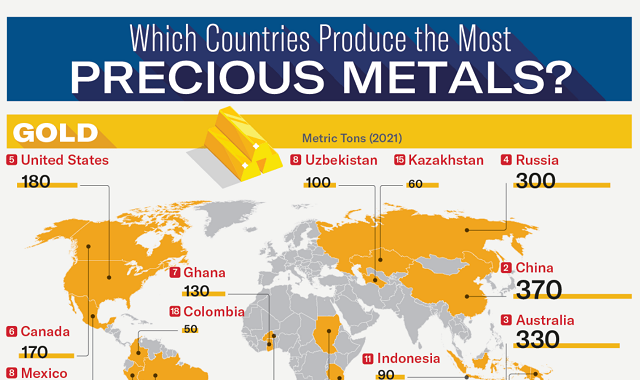
Precious metals are rare, exceptionally valuable metals that our planet naturally provides. Precious metals include gold, silver, platinum, and palladium. While gold has a reputation for being the quintessential symbol of wealth, status, and exclusivity, platinum and palladium are actually fifteen times more rare than gold. All of these precious metals offer crucial applications beyond jewelry and décor; they are used in nearly every industry, including medicine, dentistry, aerospace, automotive, and manufacturing. In fact, 11% of all gold produced is used in industry. We rely extensively on heavy metals and the countries that produce them.
Which Countries Produce the Most Gold and Other Expensive Metals? #Infographic


The Wealthiest Self-Made Women in the World and Stateside


Years ago, women from Hong Kong and China used to dominate the list of the richest self-made female billionaires, but due to the ongoing turmoil in Chinese market for many years now, self-made women from Europe and the United States are back on top of the list of females who built their own fortunes. The richest of them was Rafaela Aponte-Diamant of Switzerland, as of June 2. She along with her husband are the founder of a shipping company MSC. They created this company in 1970 and both own a 50 percent stake in it. Their expanding business has given Aponte-Diamant a net worth of more than $28 billion. According to Forbes, she is also the seventh richest woman in the world and its 49th richest person overall.

The Wealthiest Self-Made Women in the World and Stateside #Infographic

The World’s Biggest Steel Producing Countries

Steel is an important component of the modern industry and economy, as it is vital for the construction of automobiles, buildings and many other infrastructures and appliances that we use in our daily lives.


The Infographic uses data from the World Steel Association to visualize the top steel-producing countries in the world, and highlights China’s rise to the top, as it now makes up more than half of the world’s steel production.

The World’s Biggest Steel Producing Countries #Infographic

Biggest Exporters of Clothes in the World


China leads when it comes to clothing exporters from around the world. It has a record of having exported some $176 billion worth of garments in 2021, according to data from the World Trade Organization. China on its own made up a third of global exports that year. Next in the list comes the European Union, with $151 billion in exports. The bloc accounted for 28.1 percent of global figures. When looking at numbers on a country by country basis though, Bangladesh is the world’s second major exporter, having sold $34 billion worth of clothing abroad that year, which equated to just over 6 percent of exports.

Biggest Exporters of Clothes in the World #Infographic


Japan and the Netherlands have reportedly agreed for stricter restrictions on the export of chip manufacturing technology to Chinese companies.


Companies that are most likely to suffer from the consequences of the deal include ASML, Nikon, and Tokyo Electron. Bloomberg has reported that it could take months for Japan and the Netherlands to legalize the agreement.


The restriction follows Joe Biden’s order for the US to restrict chip sales to China, and has been announced in an attempt to reduce China’s access to advanced semiconductors that contributes to its military and artificial intelligence capabilities. 

Japan and Netherlands Agree on Stricter Access to Chip Manufacturing Technology for China


China Leads the Rare Earth Market


Rare earth elements (REE) are metals that have many uses in current key technologies, such as cell phone screens, wind turbines and even are used for electric motors. As the infographic shows, any one in need any of the 17 chemical elements will have a tough job sourcing them from anywhere but China. The People's Republic of China has the world's largest reserves of these not so rare metals.


China Leads the Rare Earth Market #Infographic

Top Cotton Producers around the World


We use cotton in our everyday lives. From clothes to coffee strainers, cotton is used everywhere. One more cotton product that was widely used after the spread of Covid-19 is a mask.


Cotton is the most used natural fiber and it has now become the most important non-food agricultural product. At present, nearly half of all fabrics need cotton fibers.


Using data from the United States Department of Agriculture, this infographic lists top cotton producers from all around the world


Top Cotton Producers around the World #Infographic


The Federal Communications Commission (FCC) has recently issued a ban on some of China’s leading surveillance and telecom services, including Huawei, ZTE Corp, Dahua, Hytera, and Hikvision among others, that can no longer sell their telecom and video surveillance equipment the US.


While many are deeming the FCC’s decision as controversial, the agency has claimed that the attempts are in the country’s best interests in terms of national security.

FCC Announces Ban on Several Top Chinese Telecom Services in US

What do you Aspire to be When You Grow Up?


Becoming an astronaut was a dream of many young children but it appears that this profession has lost some of its glamour, at least in the United Kingdom and the United States. Children in these regions are more interested in becoming a social media influencer rather than jetting off into space. Chinese children have opposite views, more than half (56 percent) of 8 to 12-year-olds said that they would most like to become an astronaut when they grow up and only 18 percent said they would become an influencer.


The infographic has the responses of nearly 3,000 children who were asked which profession they are most drawn to. The options given were: influencer/YouTuber, astronaut, teacher, professional athlete and a musician, as part of a 2019 study by The Harris Poll and Lego Group. They could choose up to three options.


What do you Aspire to be When You Grow Up? #Infographic

The United States and China are Reasonable for Half the World’s Household Wealth


To understand size of the economy and overall wealth, the most common method used is by calculating GDP. Although it is useful to look at economic output on an annual basis, there are other important metrics to consider when estimating the wealth of a nation.


Household wealth statistics reveal which country’s citizens are accruing the utmost level of money and assets worldwide.


This visual utilizes data from Credit Suisse’s annual Global Wealth Report to break down the latest estimates for household wealth by country.


The United States and China are Reasonable for Half the World’s Household Wealth #Infographic

The Cities with Most Surveillance in the World

This is a quite surprising fact that the global urban population has taken over the rural population. According to the records of the year 2007, the two groups were split nearly 50/50, with around 3.3 billion people apiece. In today’s date, the percentage of people who live in the urban areas has grown to be over 55% and is expected to reach 68% by the year 2050. It is because of this trend that many of the world’s largest cities have become home to millions of people.

Due to this increasing density in the urban areas, different businesses, households and also governments have installed numerous security cameras which could serve many purposes but the mainly being crime protection. To get a hold of the scale of this surveillance, data from a recent report by Comparitech is taken which helps to visualize the most surveilled cities in the world.

The Cities with Most Surveillance in the World #Infographic

Countries Accountable for most Space Junk?

Human beings in different ways have always harmed and polluted the land but, it turns out that it is not just the land that is being damaged, the space is also being polluted now. Uncountable pieces of debris that comes from broken down satellites, rocket boosters and weapon tests that have been launched over the past years have now gotten stuck in orbit. Due to this, there is clutter in the orbit which is a problem for the active satellites needed now for monitoring the Earth. The other harm is that there is a release of harmful chemicals into the atmosphere as they burn up on re-entry, using up the ozone layer, as well as potentially creating problems for future launches and space exploration.

Countries Accountable for most Space Junk? #Infographic

Subscribe Our Newsletter