What traits do the oldest people worldwide share? Madison Trust Company might have dug up answers with its insightful map displaying nations that have substantial populations aged 65 and older.
After many years of slow growth in the number of foreign workers migrating to Japan, Japan has increased its efforts to attract new foreign workers in the past couple of years. The number of foreigners working in Japan has reached a new high of more than 1.8 million in 2022. Since the Japanese population is aging quickly, the Japanese government is feeling the need to bring in talent from abroad.
According to a report by NGO Smart Growth America, the states considered to be the most dangerous ones for pedestrians in the United States are New Mexico and Florida. The two metro areas in the U.S. with the highest average rates of pedestrian deaths are also situated in these states. South Carolina, with the top 5 most dangerous metro to pedestrians, is the only other state that counted an annual average of more than 3 pedestrian deaths per 100,000 of population between 2016 and 2020.
According to a survey by Economist Intelligence Unit (EIU), only
8% of the world’s population actually lives in a full, functioning democracy.
Meanwhile, another 37% of population lives in some type of
“flawed democracy”, while 55% of the world does not live in democracy at all,
based on the EIU’s latest Democracy Index Report.
Factors that have caused numerous declines to country democracy scores in recent years include Events such as the war in Ukraine and restrictive, long-lasting COVID-19 measures. Since the source report first began tracking scores in 2006, the global average has fallen from 5.52 to 5.29.
On November 15th 2022, a significant event rocked the world: humanity’s population reached 8 billion people for the first time in history. The growing population has implications for governments and businesses, which are developing policies and strategies to address them. For example, there might be potential labor shortages as the global population ages into retirement. There are also expectations for slower GDP growth and increasing industry demands to cater to the elderly.
Our global population is getting older. It is predicted by the OECD that by 2050, 30% of people worldwide will be aged 65 or over.
Some countries are well prepared to handle the increase in
the elderly demographic, while most of the countries are already feeling the
squeeze and stress with the challenges that come with a speedily aging
population.
In order to find out which countries are well prepared to
support their senior citizens, the infographic shows a detailed view. It uses
data from the 2022 Natixis Global Retirement Index to show the best countries
to retire in around the world, based on a number of different aspects that we
will look into.
This is a quite surprising fact that the global urban population has taken over the rural population. According to the records of the year 2007, the two groups were split nearly 50/50, with around 3.3 billion people apiece. In today’s date, the percentage of people who live in the urban areas has grown to be over 55% and is expected to reach 68% by the year 2050. It is because of this trend that many of the world’s largest cities have become home to millions of people.
Due to this increasing density in the urban areas, different
businesses, households and also governments have installed numerous security
cameras which could serve many purposes but the mainly being crime protection.
To get a hold of the scale of this surveillance, data from a recent report by
Comparitech is taken which helps to visualize the most surveilled cities in the
world.
What's your favorite breakfast spot? There's a good chance that like most people, you have a favorite spot to grab breakfast in the town you live in. This infographic comes from the team at Kulick's French Toast Recipes, and utilizes Yelp reviews to determine that the most popular breakfast spots are within the 25 most populated cities throughout the United States.
US President Joe Biden has aimed a goal for around 70 percent of the world’s population to get vaccinated fully against the deadly Covid-19 virus by the end of the coming year i.e., 2022. At the moment, more than half of Biden’s goal share of the population i.e., 45 percent have been fully vaccinated against the virus.
It has been a year since the very first person received the very first official dose of the Covid-19 vaccine outside of the clinical trials, the world still has to go a long way in order to reach the target. The uneven rollout of Covid-19 vaccines in different parts of the world is a major cause impacting the vaccination rate in the country.
That is why the share of the population vaccinated around the world is also uneven. As shown in the infographic below, South America has the highest share of the population fully vaccinated i.e., 60 percent. Followed closely by Europe and Oceania with 59 percent and 56 percent of their population fully jabbed.

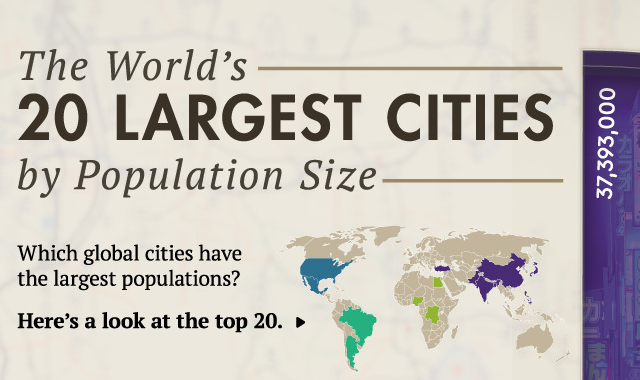
Since over half of the world’s population has shifted to the cities, it is expected that urban tenants will be seen living in the megacities in the coming years. A megacity is a term that refers to an urban area where population size exceeds 10 million people. As a matter of fact, the 20 cities mentioned in the infographic below having the largest population are all, in other words, megacities.
The world has experienced rapid urbanization in the 21st century, and hence, over 80% of people in developed and rich countries reside in urban areas whereas, about 50-80% of people from upper-middle-income countries are urban dwellers. The main reason for rural to urban migration is better job opportunities with higher salaries in cities than in rural areas.
How much can a population change in ten years? You may be interested to find out which cities in the United States have the fastest growing and shrinking populations. This infographic based on information from the U.S Census shows estimates for cities with 50,000 or more residents from July 1st of 2010 to July 1st of 2019. There are many reasons why people decide to pack up from one place and move to another. Job opportunities, housing, taxes, schools, crime, affordable housing and more.

The world’s population is continuously increasing, which is being overlooked because of other consequences going around. The infographic reveals the countries with the largest population in the world. According to the infographic, India is expected to overtake China’s population by 2022. Currently, China makes 18.5% of the world’s total population (1.44 billion people), whereas India is the second-largest by population (17.7%), being home to around 1.3 billion people. The population of China and India combined makes around 36% of the total global population.
We may think that we are living in an age where young adults are living separately from their parents. And we may also think that this trend is on the rise in the United States of America. Although as per a few studies, almost half of America's young adult population is living with their parents.
If we look back into the last few years, then young adults have suffered the most in terms of financial stability. 2020 is mirroring the year of 2008, as both the years have resulted in huge job losses for young adults across the United States. Although the effects of COVID-19 are still changing on a daily basis due to the number of cases and restrictions, this year has seen a rise in the number of young adult population choosing to live with their parents.

If we compare the continents of the world based on factors such as size, GDP, and population, we will find out that Asia is bound to top the list for obvious reasons. Firstly, China is situated in the continent of Asia, which not only makes this region the most fortunate but also the wealthiest of all; secondly, because of the size of China and the number of achievements it has managed to bag over decades of hard work, it contributes the most in the share of GDP worldwide.
The world population is increasing in millions every year. According to the United Nations, until the 21st century comes to an end, the population would be more than 11 billion. The approximation for these figures is still pretty much above 10 billion and there's no chance of it being lesser than that.
One reason is that the medical facilities available to people now were not to this extent available in the past. There were lesser vaccination, lesser medicines available in the previous two centuries that have gone by. Operation methods have also become more sustainable and thanks to technology like 3D printing, surgeries that were previously impossible, have been made relatively simple. All these advancements have added up to people having higher life expectancies.
According to UNICEF, lead poisoning in children has become a serious issue and the levels only continue to rise. An alarming number of 1 in 3 children have lead levels in their blood that are at 5 micrograms per deciliter or more than that. Lead levels in the blood marked at level 5 or higher must immediately be looked after and dealt with.
In the Islamic World, Saudi Arabia, which is also known as the Kingdom of Saudi Arabia, holds magnificent importance. This is due to it being the holy land in Islam, considering the presence of two holy mosques in KSA. The most prominent one being the Kaaba, as Muslims face it every day while performing their compulsory five-time prayers.
In terms of GDP, Saudi Arabia ranks second among all Arab states with a massive 520 billion dollars. It doesn't end here as the Crown Prince, His Royal Highness Prince Mohammed bin Salman bin Abdulaziz has the ambition to grow KSA investment even further by 2030. At the moment, KSA earns almost 2.5 the times from its exports as compared to its imports. The economical success of Saudi Arabia can also be due to its geographical location. Its location is ideal as it connects with all the three continents of Asia, Africa and Europe.
Since the population is increasing globally, it also means that the number of retired people will eventually increase. In fact, one in six people will be over the age of 65 by 2050. This will come out as a challenge for countries worldwide, as they will have to assure every retired person gets their rightful pension.