While running a business, the foremost thing for a company is to understand what its customers need and provide the best quality products to them. But how would you determine the needs and interests of your customers? That is exactly where Qualitative Data dives in. Technology has made tracking the digital behavior of a person extremely easy.
Data sciences is one of the up and coming industries in the
world right now. It is the science of data analysis and how it works. The era
of today is known as the digital era because everything is digitized, automated
and fast. If it takes your message a little more time to send due to some
internet problems, you may experience some type of frustration. This is evidence
that we have little patience because of how fast the world runs.
Believe it or not, your data is out there in the market, and
it is being sold to other companies. Have you ever wondered how accurate an
advertisement in your mail or on your social media is? It is as if your phone
is hearing you somehow and showing you the ads according to it. The accuracy of
these advertisements is spot on, and it is all thanks to your data that helps
the marketers advertise a product according to your needs.
Data brokering is a multi-billion-dollar industry that does
the business of acquiring and selling consumer data. Once consumer data is
uploaded on the internet, it is available to the data broker companies who sell
it to other companies. The industry comprises many companies that collect and
sell consumer data to other companies. It is usually done for marketing
purposes.
Data specialists and analysts use regular software programs all the time- to examine data, clean it and perform more tasks on data sets. But these programs can only handle data sets that have a specific limit, they are not designed to deal with gigantic data sets. We all know that ever since the World Wide Web has come into existence and up till now, data growth has been spectacular and of course, it is only expected to increase even more in the coming years.
From 1986 till now, we have progressed from merely 2.8 exabytes of global data storage capacity to 1700 exabytes. So it's easy to think of big data as a huge collection of data, but what is it really about? A lot of organisations have data that increases on a daily basis. One such example would be that of social media. With millions of users generating millions of posts such as status updates, photos, links and so on, it only makes sense that social media websites have a huge collection of data to deal with.
Living in an age of overwhelming data and information, it is pretty obvious that one needs to go out of their way to protect the privacy of others. With so many incidents of cyberattacks going on, it only makes sense that cybersecurity measures are being taken drastically. People fall prey to cyberattacks on a daily basis and it is not just big organisations that are being targeted by cybercriminals but small businesses and organisations make for easy targets as well.
Let's first make sense of what big data actually is. Big data is more about data that is crucial to an organisation on a daily basis, and it does not always necessarily have a huge volume. Such data is under threat when appropriate cybersecurity measures aren't taken. Examples may include infrequent change of passwords by employees, carelessly sharing personal details internally or externally, and so on. Many products and services operate online, therefore they have a lot of consumer data to handle.

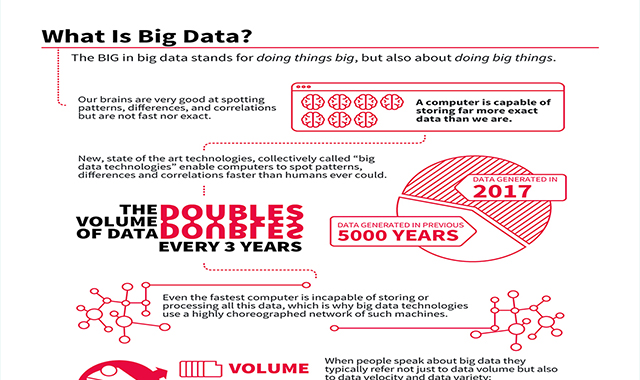
The BIG in big data stands for doing things big, but also about doing big things. Our brains are very good at spotting patterns, differences, and correlations but are not fast nor exact. A computer is capable of storing far more exact data than we are. New, state of the art technologies, collectively called “bigdata technologies” enable computers to spot patterns, differences and correlations faster than humans ever could.
The world has generated more data in 2017 than in the previous 5000 years added together. The volume of data continues to double every three years as information pours in from digital platforms, wireless sensors, virtual-reality applications, and billions of mobile phones reports the McKinsey Global Institute. Even the fastest computer is incapable of storing or processing all this data, which is why big data technologies use a highly choreographed network of such machines.
Everyone generates data: people, companies and nature itself. The more data you collect, the more informed your decisions are. Big Data is analyzed to reveal patterns, trends, and associations, especially relating to human behavior and interactions. Big Data is mostly used for predictive analytics, user behavior analytics, or certain other advanced data analytics methods that extract value from data.
Analysis of data sets can find new correlations to spot business trends, prevent diseases, combat crime and so on. Scientists, business executives, practitioners of medicine, advertising and governments alike regularly meet difficulties with large data-sets in areas including Internet search, fintech, urban informatics, and business informatics. Scientists encounter limitations in e-Science work, including meteorology, genomics, connectomics, complex physics simulations, biology and environmental research. Thus, Big Data can help answer the major questions in almost any field of activity.
Big Data – as data scientist Clive Humby called it, the new oil – has dawned and has already made significant contributions in businesses across industries. And digital marketing is of no exception. The changing customer behavior and increasing online channels are making it more imperative for businesses to invest in some form of Big Data technologies.
While relatively new and expensive for some, these tools can help analyze and provide the businesses with valuable insights from structured and unstructured data which otherwise cannot be processed by their traditional databases and analytics.
With companies making big investments in Big Data initiatives, the growing priority and urgency for Big Data analytics has become a concern and it is what this infographic talks about. It helps you understand some facts, statistics and research related to it and talks about the Big Dollars backing it up. The high expectations for such initiatives and the top business drivers for BI are also given ehre along with much more details.