Visualistan -->

    Social Items

2017 Total Solar Eclipse

Look out! The astronomical event of the year is coming August 21, 2017. This will be the first total solar eclipse in the continental U.S. in 38 years, and you’ll have to wait until 2024 for another one. Check out this sweet infographic we made to learn more about the eclipse and the best spots to watch it happen.


2017 Total Solar Eclipse #infographic

Tier 1 ERP Software insight

Top Tier 1 ERP vendors handful of statistics infographic gathers interesting facts about global main ERP competitors. Shown data should help you to make a confident decision while planning your next implementation. The fact is that Microsoft Dynamics is the most frequently short listed ERP solution and over-performs the competition in many ways.

Tier 1 ERP Software insight #infographic

Can My Dog Have

It’s difficult to refuse your dog anything at all, to be honest. But somethings are obviously not good for them and must be taken away even if they make the cutest face that could melt a stone heart.

You may have wondered what human foods your dog can actually eat. The best practice is to get allergies checked by your vet and confirm whether there are any foods your dog might not be able to swallow.

However, if you’re only wondering what kinds of foods dogs can generally eat, this infographic is a good rule of thumb to follow.

Can My Dog Have #infographic

How To Make Whiskey

we were ready to give ourselves a new challenge. For this infographic, we wanted to visualize a process and push ourselves to create a great project in a much shorter amount of time. Plus we got to make an infographic about one of our favorite hobbies.

How To Make Whiskey #infographic

Inside The Millennial Mind The Rapid Rise Of New Generation

Everyone seems to be talking about Millennials today. It’s not just because they are the largest generation by population size – though that certainly doesn’t hurt. It’s because we’re all fascinated with them – news coverage, political campaigns, and of course, marketers trying to figure out how to reach them. But beyond their size, what is it about this generation that has everyone so captivated? It’s their unique sense of self (for lack of a better word), their surprisingly optimistic outlook on life (despite the harsh economic realities they face), and their less than traditional approach to life stages.

Inside The Millennial Mind The Rapid Rise Of New Generation #infographic

The 10 Most Populous U.S. Cities Every Decade Since 1790

The United States Census began in 1790 during a time of major growth across America. As the country developed and people began to spread out, the government used it to better understand the needs of our nation.

The census has been continually changing over the past 220 years, with new questions being added as time goes on. Over time the census began collecting data on social statistics, taxation, religion, crime the census began it asked questions regarding social issues, taxes, religion, crime, health, housing, and more . The U.S. Government is even currently in debate about whether or not the 2020 census should include a citizenship question.

 When the census first began the United States had a population of just under four million people. Today the most populous city in the country, New York City, has a population more than double that of over 8.1 million people. Has your city ever landed in the top ten most populous cities in the nation during a census? Find out now on this data visualization from LibertyCruise.nyc.

The 10 Most Populous U.S. Cities Every Decade Since 1790 #infographic

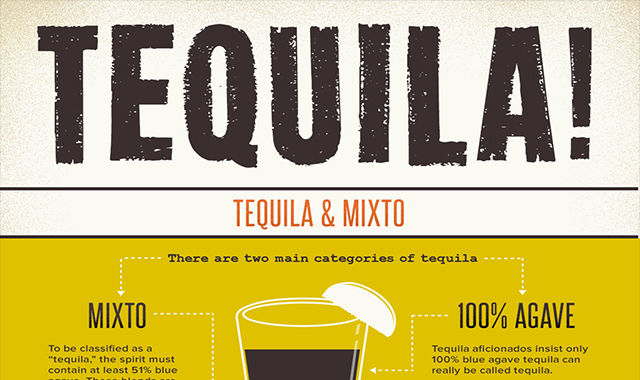
Tequila!: All About Tequila

Tequila: It’s a love/hate relationship. In honor of Cinco De Mayo and just because, team Lemonly decided to make an infographic all about tequila. Did you know legit tequila is never, ever bottled with a worm? Did you know how long it takes a blue agave plant to mature to make tequila? You’ll learn it all here and be the tequila know-it-all at your next Cinco De Mayo celebration. You’re welcome.

Tequila!: All About Tequila #infographic

From Farm To Chocolate Bar

Cocoa is usually grown on small family owned plots of land, although there are some plantations being established in Asia. In Ghana the main species of cocoa grown is called Forastero, and plantations account for only 1% of cocoa production there.

Most Ghanaian cocoa is grown on small family farms, typically of between 2-3 hectares. It is usually intercropped with other plants and trees, such as plantains (part of the banana family), maize and spices. These not only provide shade whilst the young cocoa trees are growing but can also provide up to 65% of the family's own food supply, as well as additional income.

From Farm To Chocolate Bar #infographic

Smartphone Screen Time: Baby Boomers And Millennials

Millennials have a reputation for being glued to their devices. But does their smartphone use really differ that much from other generations? To find out, Provision Living surveyed 1,000 millennial and 1,000 baby boomer iPhone users. Each respondent was asked to go into their screen time settings and record their average daily screen time.

They were then asked to record the amount of time spent on their most frequently used iPhone applications. The study revealed that both generations have similar patterned phone use—from the total amount of screen time logged daily to the most time-sucking apps. The average person spends 5.4 hours each day on their smartphone. Breaking that down by generation: baby boomers spend an average of 5 hours daily on their phones, only slightly below millennials who clock in at 5.7 hours of daily screen time.

The figures seem like a lot. In fact, they surprised 82 percent of respondents who thought their daily usage would be below that national average of 5.4 hours. So where does the time go? Both generations’ responses indicated that social media consumes the bulk of their daily screen time. Millennials log an average of 69 minutes a day on their Facebook app, while boomers are right behind them logging an average of 60 minutes on Facebook. Both generations’ second most popular app is Instagram, with millennials recording 52 minutes on Instagram daily, and boomers logging 44 minutes.

From there, the generations start to differ. It may come as no surprise that millennials’ third most time-absorbing application is text messaging. Young adults spend three quarters of an hour messaging people they know, and an additional 41 minutes, on average, talking on the phone. Baby boomers, on the other hand, spend their time using e-mail and messenger apps before sending text messages or talking on their phone. At the end of the day, both generations spend a fair amount of time surfing the internet on their phones. Nowadays, roughly 60 percent of adults use their smartphone as their primary internet service provider. Americans have grown accustomed, if not dependent on their smartphone.

That overwhelming majority of respondents, some 94 percent, believe that smartphone addiction is a real thing. People have a hard time being away from their devices, fearing missed calls and messages even in the middle of the night. The survey revealed that nine out of ten people sleep with the phone within arm’s reach of them in bed. Even after learning just how much time they spend each and every day, staring at, watching and listening to their devices, two in three people say they have no plan to cut back on their daily screen time.

 Apple has tried to draw attention to people’s apparent dependency on their smartphones by creating pop-up alerts tracking whether a user’s screen time is “up” or “down” from previous weeks. But this study revealed that even with that information, consumers are still going to type, talk, watch, Tweet, and everything else under the sun on their phones without any major concerns.

Smartphone Screen Time: Baby Boomers And Millennials #infographic

What Goes Up In a Down Economy

What could tattoos, luxury retail, and candy possibly have in common? Well, from an economic perspective, they are all part of industries that seem to do exceptionally well even during downturns – but why? Moving through fairly predictable phases, the state of the economy may once in a while through us a curveball.

Impending recessions leading to a potential depression leaves our economy and personal financials in shambles. The stock market crash of 1933 brought on the Great Depression and an unemployment rate of 25%; decades later, the Great Recession was triggered when the subprime mortgage bubble burst, some effects of which we are still dealing with to this day. Yet even in the face of such economic uncertainty, there is always enough pocket change for a treat.

 From our vices to necessities, here’s more on the industries that survive and thrive during economic dips, what we can learn from their success, and use those lessons to help our own business succeed no matter the economy.

What Goes Up In a Down Economy #infographic

Secrets to Living Longer: What We Can Learn from Blue Zones

By 2050, it is predicted that earth will be home to over 3.5 million centenarians, that is, people over the age of 100. At every point in time, human beings have been searching for the secret to longevity – the answer may lie in the planet’s Blue Zones. Blue Zones are understood as geographic areas of particular good health and longevity.

These regions show lower rates of dementia and Alzheimers, lower risk of middle-age mortality, and higher concentrations of centenarians than anywhere else. But what is it really that makes these Blue Zones so special? Blue Zones Okinawa Japan, Ikaria Greece, Loma Linda California, and Nicoya Peninsula Costa Rica, may have very little in common with one another in terms of culture and citizens, but it’s these striking differences among Blue Zones that helps us understand the patterns of longevity.

The power of Blue Zones can be seen in the lives of the people that live there; applying these qualities to our own lives is the tricky part. Here’s where to start, detailed in this infographic for more.

Secrets to Living Longer: What We Can Learn from Blue Zones #infographic

Neighborhood Guide: New Orleans

Experience the “Big Easy” with our New Orleans neighborhood guide. You’ll quickly become an expert on all the diverse art, culture, cuisine, architecture and entertainment there is to enjoy in neighborhoods like the French Quarter, Garden District and Mid-City.

Neighborhood Guide: New Orleans #infographic

Subscribe Our Newsletter