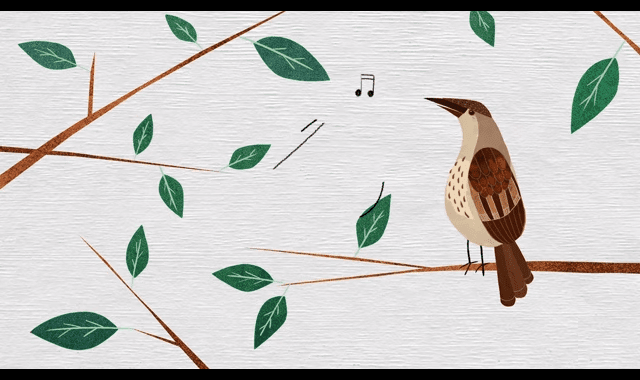
Bird song may sound like whimsical fun to humanity, but for birds, it is a complex system with vital functions. The first primary purpose of bird vocalization is to attract mates – experiments suggest that the quality, variety, and power of a bird’s song may be a good indicator for physical fitness. The second primary purpose of the bird song is territory defense.
Territorial bird species such as ravens, blue jays, European robins, and swifts use bird song to negotiate territorial boundaries. Researchers believe that since song quality may be indicative of a bird’s strength and health, individual birds can interpret how formidable their rivals are and thus avoid futile fights.
Birds also communicate through song, sometimes even across species. For example, mobbing calls are used to recruit individual birds in the area to rally together and drive out an owl or other predators.
This infographic explores the sounds made by 50 species, offering a glimpse into the mosaic musical communication of bird song. Be sure to check out AAAStateofPlay.com to play around with the interactive version!
Williams scrapped all Flappy Bird's written app reviews in iTunes before the game was deleted; this gave more than 68,000 written reviews to a database, and he was kind enough to share a CSV file of that information with Mashable. Using it, when the app began to gain traction, its ratings and the overall user feeling around it, we were able to look for trends.
The pure success of the game has resulted some critics to accuse Nguyen of using shady practices— including purchasing traffic or paying for fake reviews — to assist Flappy Bird climb up the app charts. However, after looking at the data that matches when Flappy Bird started building word-of-mouth buzz, we can't discover any indications of improper reviews or ratings being manipulated.
The fact that Flappy Bird was not a scam— but a spectacle that occurred naturally from nowhere — only makes its triumph much more amazing and its withdrawal from the App Store much more bittersweet.
Sharks, snakes, spiders… some creatures are universally understood to be creepy. But, in our latest infographic, we give you the unfortunate news that there’s another member of the animal kingdom that should induce a high-pitched scream. Owls. Bring to mind their curious eyes, majestic posture, and (unwarranted) reputation for being wise, and you might come to the conclusion that owls are okay. Kinda cute even, right?
A brown thrasher knows a thousand songs. A wood thrush can sing two pitches at once. A mockingbird can match the sounds around it — including car alarms. These are just a few of the 4,000 species of songbirds. How do these birds learn songs? How do they know to mimic the songs of their own species? Are they born knowing how to sing? Partha P. Mitra illuminates the beautiful world of birdsong.
Have you ever seen an amazing feather design, whether it was on something decorative, or on someone's tattoo, and wondered where the idea came from? There are so many incredible birds that can be found across the skies of North America, and while they may not be as unique as tropical birds, they're still interesting to study and take photos of!
Easily, the Golden Eagle has the large feather on this infographic, followed closely by the Bald Eagle's feather. Meanwhile, you have birds like the Lazuli Bunting, Green Kingfisher, and the Grasshopper Sparrow which all have incredibly small feathers that pale in comparison to the two types of Eagles.
This infographic will help you identify all different types of tail feathers that you might encounter across North America. Which is your favorite from these 60 tail feathers of these birds that call North America home?
Easily, the Golden Eagle has the large feather on this infographic, followed closely by the Bald Eagle's feather. Meanwhile, you have birds like the Lazuli Bunting, Green Kingfisher, and the Grasshopper Sparrow which all have incredibly small feathers that pale in comparison to the two types of Eagles.
This infographic will help you identify all different types of tail feathers that you might encounter across North America. Which is your favorite from these 60 tail feathers of these birds that call North America home?
Consider the strongest, smartest, and most adored animals on the planet- what comes to mind?Astonishingly enough, the boring gray bird - known for populating rooftops and eating breadcrumbs - has been loved by mankind because of it's physical and mental abilities for thousands of years. A deeper appreciation for something as mundane as a pigeon, may reveal many more incredible things hiding in plain sight.
There are around 10,000 species of birds that exist on this planet that we know of. They come is many different sizes, shapes and colors and can have some very unique features and characteristics. In this collection we take a look at some of the most popular types of birds you can find around North America (U.S. Mexico and Canada).
With summer fast approaching, now is the ideal time to get your garden in tip-top shape. As well as de-weeding and replanting, you can also take steps to make your garden more nature friendly, especially when it comes to native birds. Data from the RSPB revealed that the Blue Tit is the most common garden bird, but if you’re looking to attract rarer varieties such as the Eurasian Bullfinch or the Jackdaw, consider following these simple steps:
Birds will usually feed themselves in the wild, but in the colder weather it’s sometimes a good idea to give our feathered friends a little help. Before you throw away your plastic drinks bottles, have a look at this infographic. It shows you how you can use simple items you might already have at home - like bottles, pencils, string and scissors - to create an eco-friendly (and very inexpensive) bird feeder. Parents and teachers can also get the little ones involved in this easy-to-do activity. Kids can not only have fun making the feeder, but enjoy spotting the different kinds of wild birds that could be gathering in the garden as a result! The RSPB provides a handy bird identifier on their website to help you put a name to your winged visitors. Remember to use any of the equipment listed safely, and enjoy welcoming some new presences to your outdoor space!
Subscribe to:
Comments (Atom)